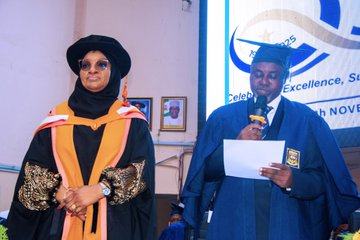
Ensuring that synesthetic drugs and herbal drugs are considered as the same in terms of importance and value, and making sure that there is absence of discrimination will help to achieve the desired healthcare advancement in the country, a professor of Pharmaceutics and Industrial Pharmacy at the University of Ilorin, Professor Adeola T. Kola-Mustapha, has submitted.
Team@orientactualmags.com learned that Professor Adeola T. Kola-Mustapha said this while delivering her inaugural lecture at the Main Auditorium of the university last week.
It was University of Ilorin’s 285th inaugural lecture and it was titled ‘Rooted In Nature, Refined By Science: A New Horizon In Advanced Drug Delivery’.
Citing nanomedicine that became known in the late 90s which is the application of nanotechnology to medicine, she added that natural and synthetic medicine integration now features design and development of a novel drug delivery system that enables the ‘co-utilization of both medicines either for synergistic impact or for supporting the activity and appeal of either, to the consumer’.
Asserting that natural medicines therapeutic products derived from plants, animals, and minerals are as effective and measurable as synthetic products, she noted however that there is no medicine without side effects.
‘For emphasis, natural and synthetic medicines are complementary, they have always been. By reformulating natural medicines in synthetically appearing formulations such as emulgels and suppositories, we redefine the user’s perception of traditional medicine and enhance its use by the people. By improving synthetic medicines with naturally occurring excipients, we strengthen its effects and alleviate drawbacks in its production and use.
By combining both for activity, we achieve a synergism in benefit that exceeds the sum of its parts’ Professor Adeola added.
She however noted that there is a need to embrace novel trends and developments in pharmaceutical formulation and development adding that ‘computation drug analysis with bioinformatics tools is here to stay and is now a gold-standard in many countries’.
Recommending ‘equal status’ for synthetic drugs and natural medicine, she also proposed a ‘one-in-one’ relationship and not ‘side-by-side’ relationship.
‘The goal of integration is not to place natural and synthetic medicine side by side in a pharmacy, but that they are co-developed until one is indistinguishable from the other. Indigenous pharmaceutical formulation practices should aspire to equal standards of quality, appeal and activity for natural and synthetic medicines and continuously attempt the co-formulation of both for the better health of Nigerian patients’ Professor Adeola submitted.
She also asserted that ‘no medicine is perfect’ the focus should therefore according to her be on ‘safety and standardized dose’.
‘Every drug is a poison and should be used with caution, whether natural or synthetic. To my fellow scientists, let us bring to the fore prevalent issues in medicinal development and use in patients. Scientists should continuously strive to identify active plant components, determine safety and standardized dose, and further improve drug formulation for industrial efficiency and patient benefit’ she added.
Professor Adeola also noted that ‘all herbal remedies are natural drugs’, while it is not all natural drugs that are herbal.
‘Herbal remedies are plant-based and represent just one source of natural medicines while synthetic medicines are artificial or chemically modified versions of natural compounds, and they play an equally vital role in disease treatment’ she said.
Professor Adeola T. Kola-Mustapha also noted that it would be of great benefit to the University of Ilorin to consider the development of in-house production capacity for the commercialization of novel medicine formulations submitting that ‘the Nigerian populace is hungry for ‘made-in-Nigeria’ and will not hesitate to patronize products produced by the university’-Team@orientactualmags.com Do you have any information you wish to share with us? Do you want us to cover your event or programme? Kindly send SMS to 08035023079, 08059100286, 09094171980 or get in touch via orientactualmag@gmail.com. Thank you