Beyond Ethnic Sentiments: Why Prof. Farooq Kperogi Got Kwara Politics Wrong-Ibrahim S. Jawondo
Farooq Kperogi’s column sounds forceful on the surface, but it rests more on speculation, selective history, and emotional framing than verifiable political reality in Kwara State. The Professor’s line of argument is in real terms misleading the very people he claims to defend.
First, the foundation of his claim that President Asiwaju Bola Ahmed Tinubu is plotting to “impose” a Yoruba governor on Kwara is speculative. Even the writer admits he did not witness any such directive. Building an entire argument on “whispers and speculation,” “it is said,” and unnamed sources is not analysis; it is conjecture. In a democracy, candidates emerge through party processes and elections, not through rumours dressed up as realities.
Second, the attempt to frame Kwara politics as a looming ethnic confrontation is exaggerated. Kwara has historically thrived on political pragmatism rather than ethnic divisions. The so-called “Yoruba agenda” being alleged ignores the reality that Kwara’s political identity especially in Ilorin has always been a blend of cultures and allegiances (a typical case of Baba Saraki political era is an example). Reducing this complexity to a ethnic domination narrative is not only inaccurate but potentially dangerous.
More importantly, the claim that Kwara North has been completely excluded from power ignores recent political realities. In the 2023 elections, Kwara North was given a clear opportunity within the People Democratic Party structure. A candidate, Alhaji Yamma Abdullah, emerged from the zone and was presented to the electorate. The outcome was decisive: his people from Kwara North did not rally behind him. That is not marginalization; that is democracy at work. You cannot argue exclusion when the ballot was available and the voters made a different choice.
Kperogi also deceptive over the role of competence, structure, and political investment in leadership selection. Governance is not a compensation scheme; it is about capacity, good track record, and the ability to win elections. Zoning can be a guiding principle, but it cannot however override merit or popular support. Suggesting that power must rotate purely on ethnic or regional sentiment risks lowering the standard of leadership and undermining democratic choice.
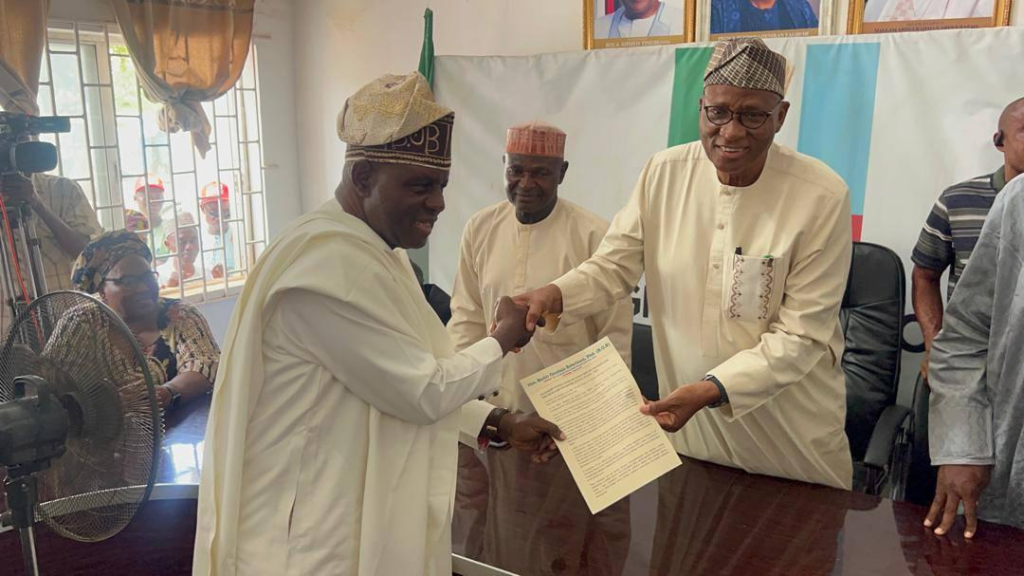
On the issue of Bashir Omolaja Bolarinwa, the attempt to brand him as an outsider or a “Lagos import” is misleading. Bashir Omolaja Bolarinwa has been deeply rooted in Kwara politics long before the OTOGE Struggle. As state party chairman, he played a central role in the political transformation that led to the sweeping victory of the APC across all elective positions in 2019 starting from Governor, National Assembly, House of Representative and State Assembly. That is not the profile of an imposed outsider; it is the record of a political stakeholder with proven grassroots structure and leadership experience.
The writer’s argument also contradicts itself. He acknowledges that political power is often symbolic and that politicians primarily serve their inner circles, yet he insists that only a governor from a particular zone can address development gaps. Development is driven by policy, vision, and governance priorities, not merely by ethnic origin. Kwara North’s developmental challenges are real, but solving them requires strategic governance, not by playing ethnic cards.
Finally, the tone and pattern of Kperogi’s recent interventions suggest a clear political leaning rather than neutral analysis. His framing aligns closely with opposition narratives designed to create distrust within the ruling party and create divisions where consensus is gradually forming. That is his right as a commentator, but it should not be mistaken for objective truth.
The path forward for Kwara is not based on ethnic mobilization or speculative alarmism. It is about allowing a level playing field where all qualified aspirants regardless of zone or ethnic background can present themselves, and the people can freely choose the best among equals.
Kwara voters are politically aware and capable of making informed decisions. Attempts to box them into ethnic sentiments or portray them as victims of an impending imposition underestimate their level of political awareness. The real democratic ideal is simple: open competition, credible candidates, and the will of the people.
Thank you.
I rest my pen- Ibrahim S Jawondo writes from Ilorin, Kwara State